
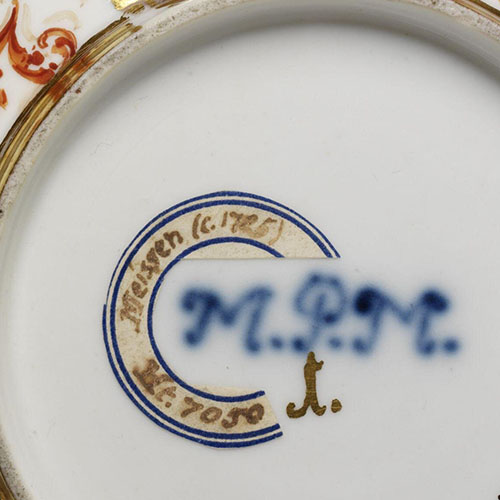
1722 (made), 1722-1725 (decorated).
The decoration on this teapot, with Chinese figures delicately painted in polychrome enamels and framed in iron red, pink lustre and gilding, is characteristic of much painting at Meissen from the early 1720s to the 1740s. This is an early example, as the teapot has the rare mark ‘M.P.M’ (Meissener Porzellan Manufaktur’ or Meissen Porcelain Factory) used only in 1722, before the factory introduced its famous crossed swords mark. The decoration, however, is a few years later. Both the specific type of Chinese figure designs used on this pot, and the full palette of enamel colours used to realize them, were innovations introduced by Johann Gregorius Höroldt (1696-1775), an artist who had previously worked at the Vienna porcelain factory. Meissen had struggled to decorate its porcelain with colours until Hörold was appointed in 1720. During the 1720s Hörold developed new enamel colours and processes and introduced new designs, including the type of Chinese figure scenes used here. Known as ‘chinoiseries’ in the West, these portray China a fairy tale land with exotic landscapes and quaintly-dressed inhabitants engaged in leisurely pursuits. Over a thousand individual sketches for figure subjects of this type are included in a design book he began compiling in 1723-1724 (the ‘Schulz-Codex’), and he published six others as etchings in 1726. By 1730 he was supervising 46 painters of chinoiseries.