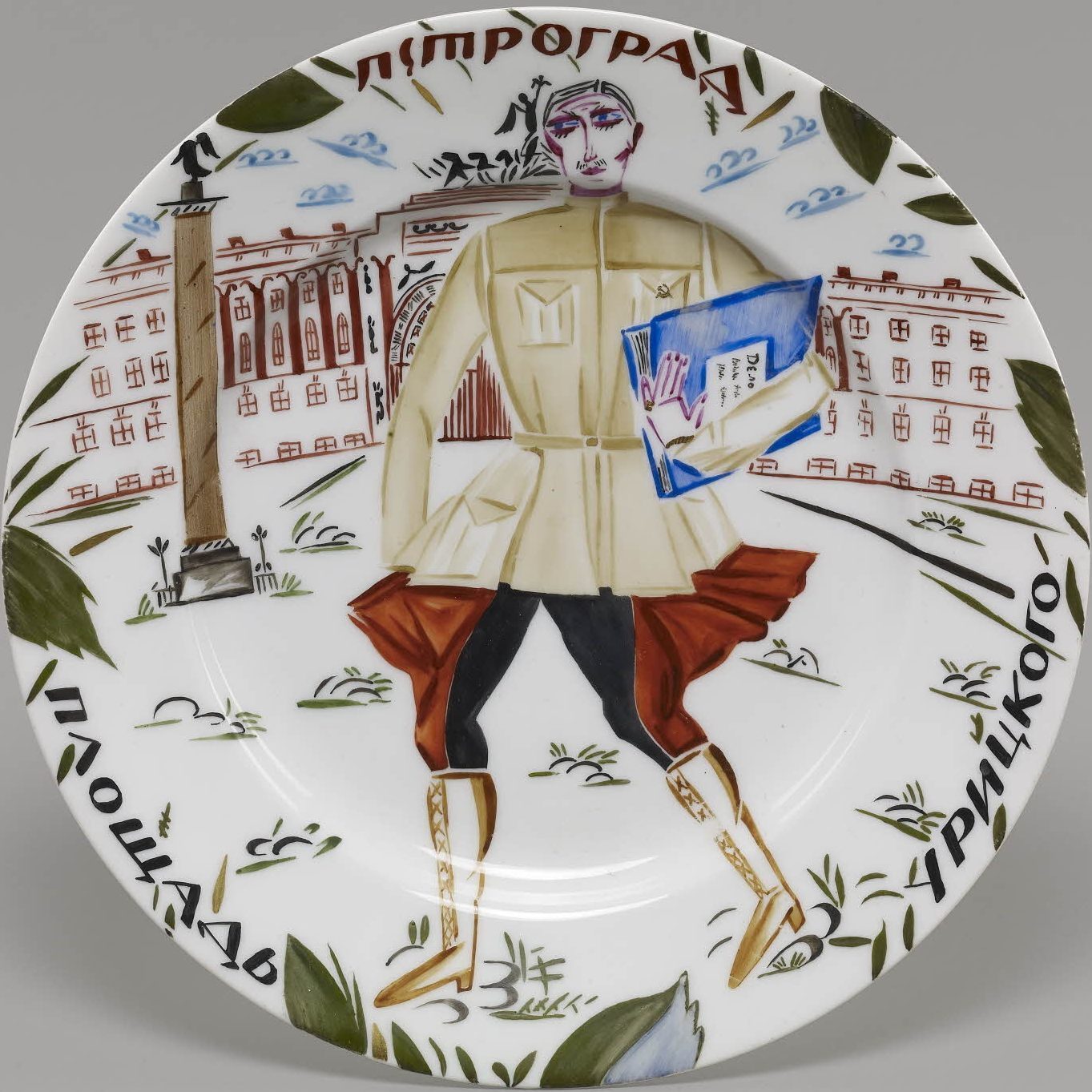

The Commissar is dressed in jodhpurs, military jacket, and lace-up boots holding a file in his hand as he strides across Palace Square (then known as Uritsky Square) with the General Staff Building and the Alexander Column in the background.
Shchekotikhina-Pototskaia’s rapid brushwork and folk-influenced designs made this view of a Commissar, one of the new masters of Soviet society, a popular design and it was frequently copied both for distribution within Soviet Russia as well as for exhibitions abroad. The commissar was a position introduced by Leon Trotsky during the Civil War. They oversaw the political education of the troops and the loyalty of commanding officers, many of whom had served in the Imperial army. The commissars held no official position in the military but could overrule a commanding officer’s order if they suspected him of counter-revolutionary activity. Between 1918 and 1944, the now renamed Palace Square was redesignated in honor of Moisei Uritsky (1873-1918), the Commissar of Petrograd’s Constituent Assembly and Head of the city’s branch of the ChEKA, who was assassinated there on August 30, 1918 by Leonid Kanegisser, a military cadet and member of the political opposition. The event was the prelude to the so-called “Red Terror”.
ГФЗ – Государственный фарфоровый завод, Санкт-Петербург.
Автор композиции: Щекотихина-Потоцкая