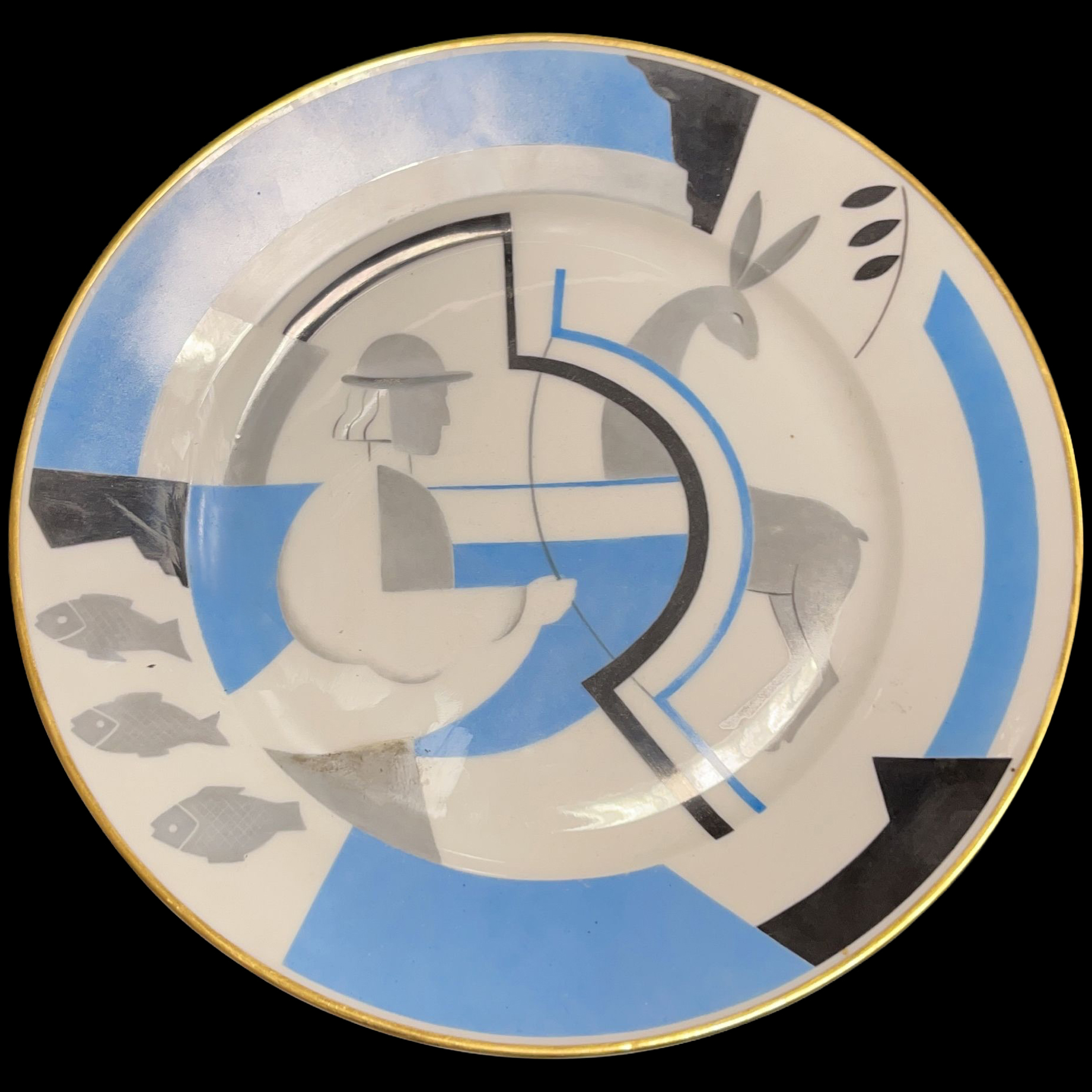
The 1920s production of “Baltars” porcelain and faience painting studio is an outstanding realization of Art Déco in Latvian applied arts. It left its indelible mark on the development of art porcelain and Latvian decorative arts and formed an important part of Latvian Classical Modernism of the 1920s. The limited editions of its products became well regarded and popular among the public and critics alike and also received international acclaim.
The workshop was established by Romans Suta in 1924 and existed until 1929, but was most productive between 1925−1927 when about 300 unique pieces were created: mostly decorative plates, vases and china sets. It cultivated a creative environment where artists were able to combine the ethnic tradition with modern art. He found several like-minded colleagues and together they established “Baltars” (a play on the Latin phrase ars Baltica – Baltic art). In addition to Suta, the other two leading artists at “Baltars” were graphic artist Sigismunds Vidbergs (1890–1970) and the talented painter Aleksandra Beļcova (1892–1981). Important for the development of “Baltars” unique style were also the painters Erasts Šveics (1895–1992) and Lūcija Kuršinska (1894–1976) as well as Dmitry Abrosimov, the experienced technologist who was responsible for transferring the artists’ designs onto the actual objects.
“Baltars” aimed at finding an innovative artistic solution to painting porcelain and realize Suta’s idea of combining the Latvian folk tradition with cubism, constructivism, Art Déco, and other modernist visual styles. Each of the leading artists expressed him/herself in their characteristic way, but they shared the ability to vary abstract motifs in different forms and relationships between line and colour.
Romans Suta brought to “Baltars” the motifs and themes in which he was interested in easel-painting: country life, the hustle and bustle of the big city, theatre and carnival motifs, as well as historical subject matter; he also made many designs that centred on the theme of wedding.
Aleksandra Beļcova’s choices in motifs and composition were similar to Suta’s, but her special touch was bright, saturated colours and work in the Suprematist style, which in time was replaced by a return to realistic forms and precision in drawing.
The third “Baltars” star designer Sigismunds Vidbergs was a graphic artist with a penchant for laconic, black-and-white compositions in style, but not in subject matter, somewhat akin to Aubrey Beardsley. His work exhibited influences from futurism, Art Déco and, on occasion, Art Nouveau.




As leading experts on antique European porcelain, we provide FREE online appraisals of Baltars porcelain. If you happen to own one the plates or vases listed above, and would like to find out its current market value, CONTACT US. We’ll be glad to assist.