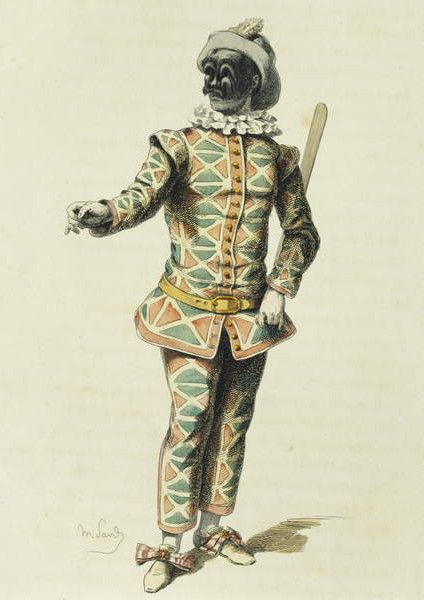
Model Number: S 131
Modeled c.1899 by Emmerich Andresen after a drawing by Maurice Sand, 1860.
Commedia dell’arte is a theatrical form characterized by improvised dialogue and a cast of colorful stock characters that emerged in northern Italy in the fifteenth century and rapidly gained popularity throughout Europe.
Each character of the commedia evolved a distinct set of attributes—characteristic speech, gestures, props, and costume that became standard to the portrayal of the character. Most characters wore masks, a tradition deriving from ancient Roman comedies.
Perhaps best known of these is Harlequin, a character whose origin is contested. It is likely that he derived either from Alichino, a demon from Dante’s Inferno (XXI–XXIII), or from Hellequin, a character from French Passion plays, also a demon charged with driving damned souls into Hell. Harlequin is characterized as a poor man, often from Bergamo, whose diamond-patterned costume suggests that he is wearing patchwork, a sign of his poverty. His mask is either speckled with warts or shaped like the face of a monkey, cat, or pig, and he often carries a batacchio, or slapstick. Though usually a brilliant acrobat, Arlecchino is gluttonous, illiterate, and gullible.