

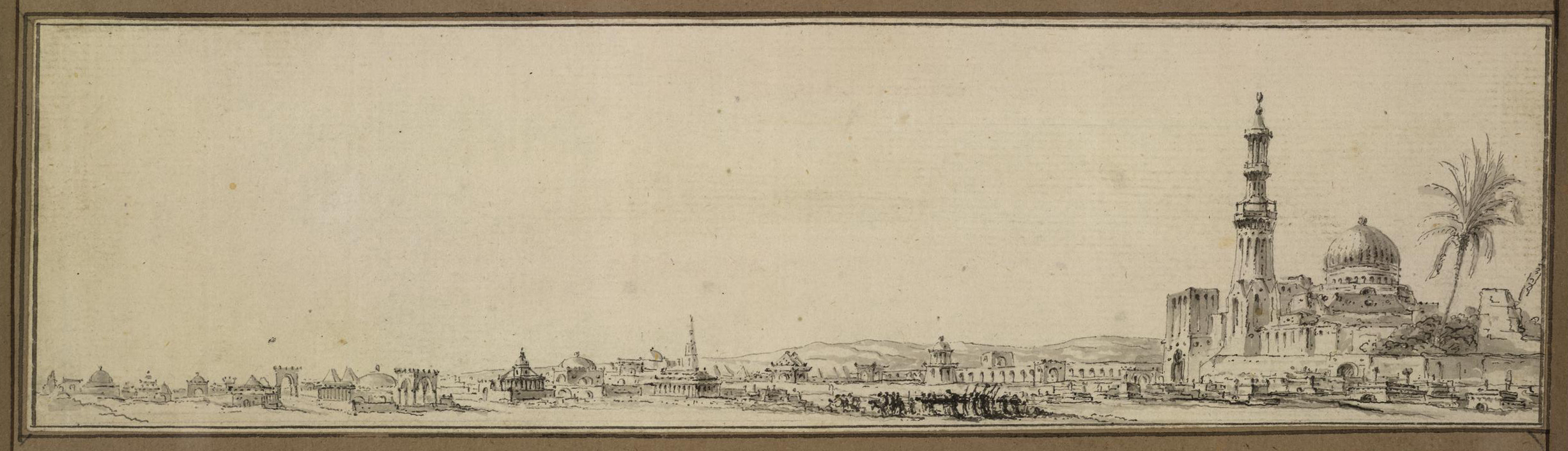
After “Cimetière des Mamlouks” (Cemetery of Mamluks) from illustrations by Vivant Denon (1747-1825) for the published description of his journey to Egypt during Bonaparte’s 1798 campaign, Voyage dans la Basse et la Haute Egypte (1802). Denon was an artist, curator and author who worked in Italy and France and was Napoleon’s Minister of Arts and first director of the Musée Napoléon (Louvre) (1802-15).
Mamluks were slave soldiers, often of Turkic or European origin, who formed a powerful military class that ruled Egypt and Syria from 1250 to 1517, eventually establishing a dynasty known as the Mamluk Sultanate.
The term “mamluk” literally means “owned” or “slave” in Arabic. These soldiers, initially recruited from Central Asia and the Eurasian steppes, were bought or captured and trained as warriors, often converting to Islam and learning Arabic.
The Mamluks initially served under the Ayyubid dynasty, but they eventually overthrew the last Ayyubid sultan in 1250, establishing their own rule in Egypt and Syria. The Mamluks formed the backbone of the military in Egypt, and their military prowess allowed them to expand their influence and establish a powerful dynasty.
The Mamluk Sultanate, based in Cairo, controlled Egypt, Syria, and parts of Anatolia, Upper Mesopotamia, and the Hejaz.
Mamluk history is often divided into two periods: the Bahri period (1250–1382), dominated by Mamluks of Turkic origin, and the Burji period (1382–1517), dominated by Mamluks of Circassian origin.
The Mamluk Sultanate eventually declined and was conquered by the Ottoman Empire in 1517.
They left a significant cultural and architectural legacy in the region, and their rule had a profound impact on the history of Egypt.