
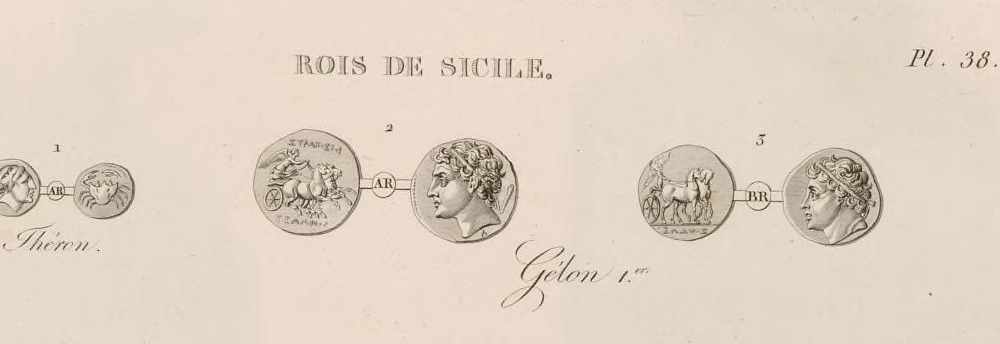
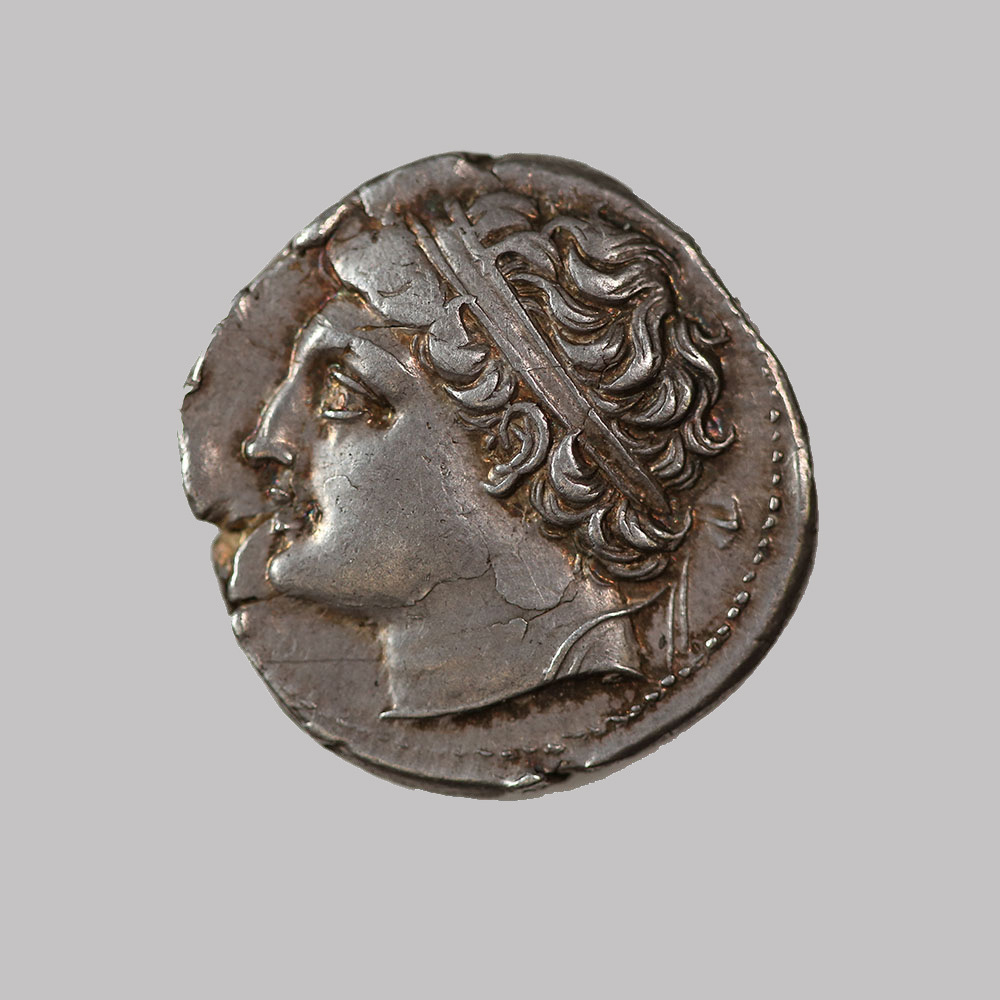
After the engraving from “Iconographie grecque” (Pl.38) by Ennio Quirino Visconti published in 1808 in Paris, depicting an ancient coin.
Gelon of Syracuse was a prominent figure in ancient Sicily, ruling as tyrant of Gela (491–485 BCE) and subsequently Syracuse (485–478 BCE).
His reign was characterized by expansion, strategic alliances, and military successes that significantly impacted the region.
Gelon rose through the ranks as a military leader under Hippocrates, the ruler of Gela.
Following Hippocrates’ death, Gelon seized power in Gela.
He later took advantage of internal strife in Syracuse, making himself the city’s ruler in 485 BCE.
Under Gelon, Syracuse flourished, experiencing rapid growth in population and becoming a major center of power.
He expanded his territories by conquering neighboring cities like Euboea and Megara Hyblaea, relocating their wealthier citizens to Syracuse.
Gelon also invested in infrastructure, including building temples and other public works, contributing to the city’s prosperity.
Gelon built a strong fleet and recruited a large mercenary army to enhance Syracuse’s military strength.
He played a crucial role in defending against a Carthaginian invasion of Sicily, leading the Greek forces to victory at the Battle of Himera in 480 BCE.
This decisive victory helped protect Sicily from Carthaginian control for decades.
Gelon was widely respected during his time, and his statue was even spared by Timoleon, who sought to remove traces of other tyrants from Sicily.
He is remembered for his leadership and success in transforming Syracuse into a dominant power in ancient Sicily.