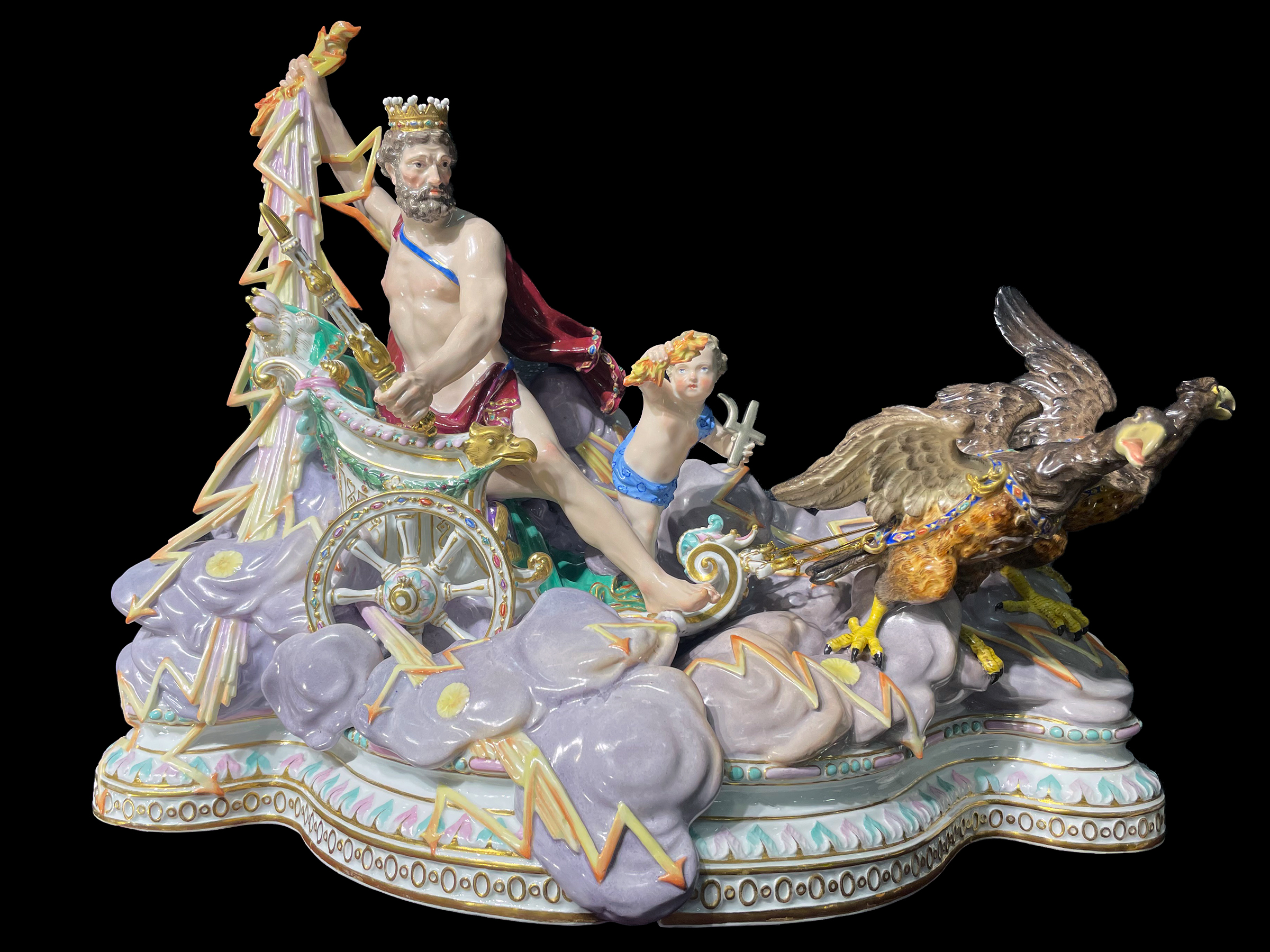
Modelled by J.J. Kaendler, the crowned god draped in a purple cloak, leaning on his chariot raising a thunderbolt, his chariot pulled by two eagles, flanked by a putto holding the astrological symbol for Jupiter, all raised on a bed of clouds mounted on an ornamental neo-classical base, made in two parts, held together with original bolts, 54cm wide.
This group was first modeled in part by Kaendler and in part by Acier, as part of an elaborate gift for Czarina Catherine II, the so-called ‘Great Russian Order’, of porcelain made for the Russian court. It was intended for decoration of the Katalnaya Gorka or ‘Sliding Hill’ pavilion near Oranienbaum Palace outside of Saint Petersburg. They were modelled by Johann Joachim Kaendler and based on the five planets known at the time, Mercury, Venus, Mars, Jupiter and Saturn, as well as the sun and the moon, which were also called planets.
Kaendler’s inspiration for the original designs of this series may be found in the Gründliches Mythologisches Lexicon (Leipzig, 1724). The original print source for these large-scale mythological groups however can more likely be found in the series of ‘Seven Planets’ which were published widely in Europe in the second half of the 16th century. They could very well be based on works by the same title published around 1600 by the Dutch engraver Crispijn (van de) Passe the Elder (1564-1637), or indeed the ‘Planetarium – Effectus et Eorum in Signis Zodiac’ by engraver Johannes Sadeler published in Antwerp in 1558, which both show Mars in his chariot flanked by his zodiac sign. Both engravers based their prints on works of Maarten de Vos. Interestingly, Anthony Griffith, The Print Before Photography (2016), notes that of the 1600 prints made after Maarten de Vos, only two were derived from paintings, the majority having been supplied directly to an engraver.