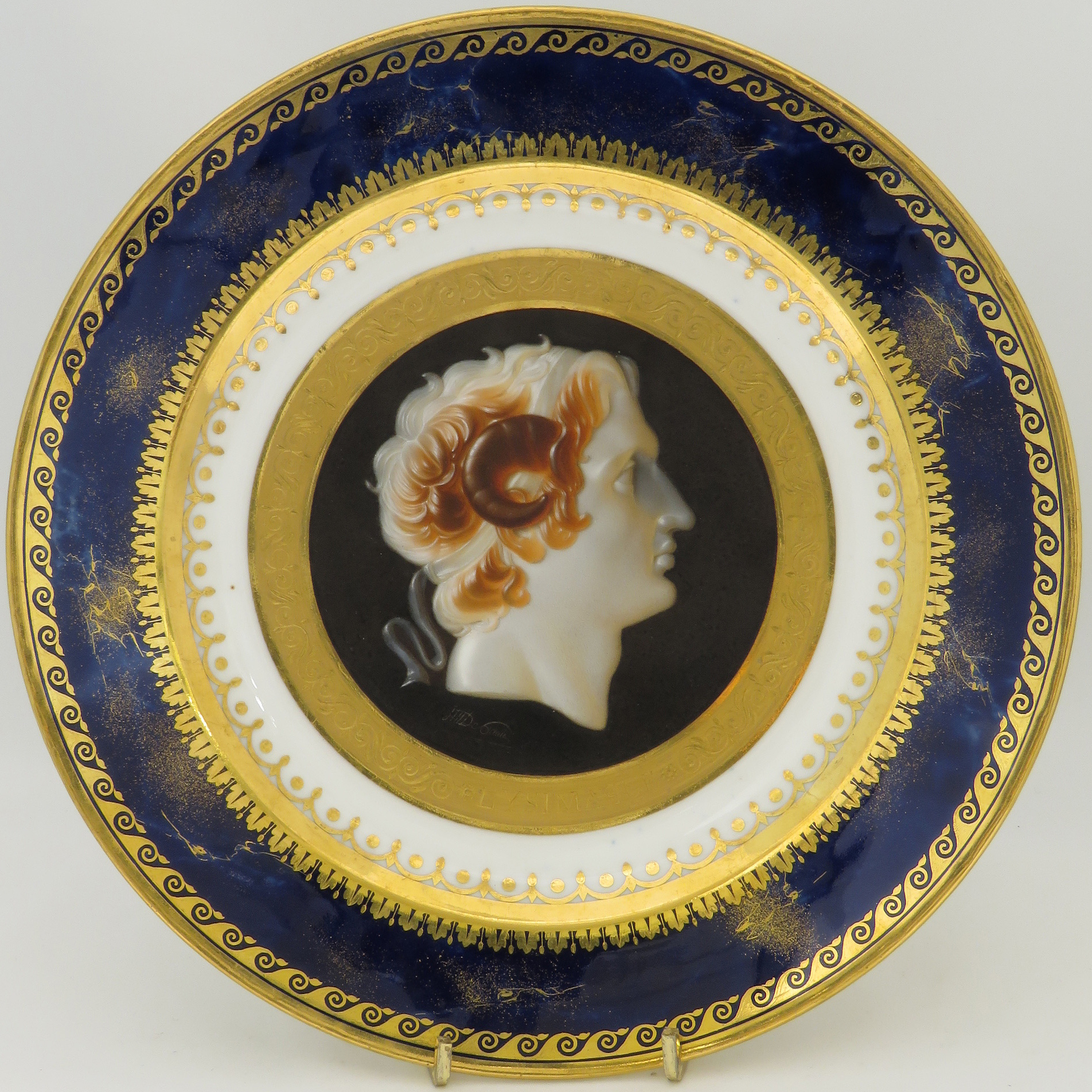
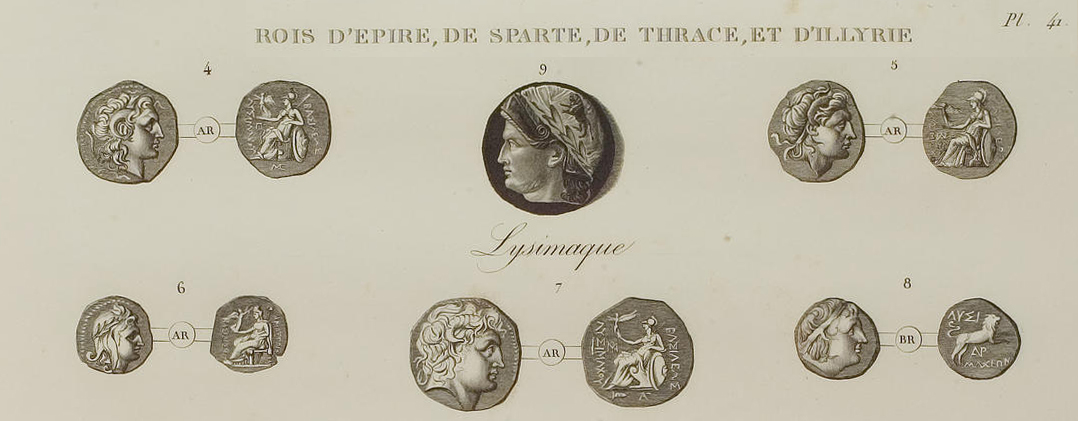
Following the premature death of Alexander the Great in 323 BCE, his generals, friends, and heirs engaged in forty years of wars over his empire. Lysimachus (reigned 323–281 BCE), one of Alexander’s companions and bodyguards, used the king’s image on his own coins in order to cast himself in the role of successor and legitimize his claim to the kingdom of Thrace. Alexander, responsible for establishing the conventions of royal portraiture, is depicted in his preferred manner: youthful and clean-shaven, with long locks of hair rising above his forehead and eyes cast upward. Additionally, he is shown with horns curling around his ears. These “horns of Ammon” symbolize Alexander’s claim that he was the son of the Egyptian god Ammon—a claim reportedly confirmed by the oracle at the sanctuary of Zeus-Ammon at Siwa, Egypt.
After the engraving from “Iconographie grecque” (Pl.41) by Ennio Quirino Visconti published in 1808 in Paris, depicting an ancient coin